...............................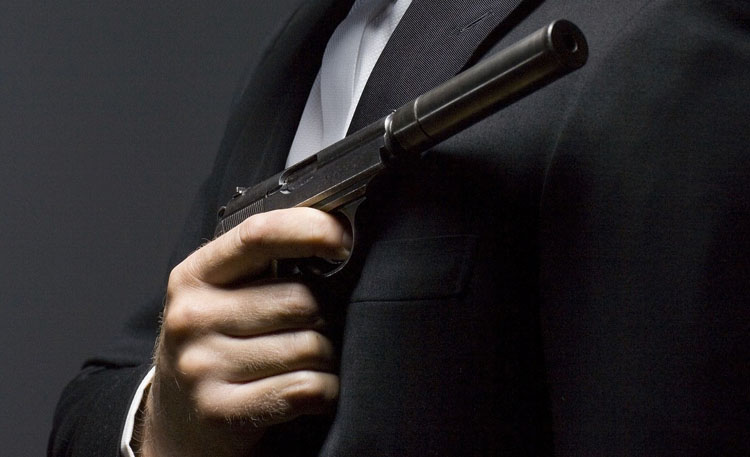
"Walther PPK. 7.65 mm, with a delivery like a brick through a plate glass window. Takes a Brausch silencer with very little reduction in muzzle velocity. The American CIA swear by them."
- Major Boothroyd to 007, Dr. No
The Gun: Walther PPK
The Walther PP series pistols are blowback-operated semiautomatic pistols.
They feature an exposed hammer, a double-action trigger mechanism, a single-column magazine, and a fixed barrel which also acts as the guide rod for the recoil spring. The series includes the Walther PP, PPK, PPK/S, and PPK/E.
They are manufactured by Carl Walther GmbH Sportwaffen in Germany, Manurhin in France following World War II, and then in the United States by Interarms in Alexandria, Virginia and currently Smith & Wesson. All production has been under license from Walther.
The most common variant is the Walther PPK, the Polizeipistole Kriminalmodell (Police Pistol Detective Model), indicating it was more concealable than the original PP and hence better suited to plainclothes or undercover work. Sometimes, the name Polizeipistole Kurz (Short Police Pistol) is used, however the accuracy of that interpretation is unclear. The PPK is a smaller version of the PP (Polizeipistole) with a shorter grip and barrel and reduced magazine capacity.
The PP was released in 1929 and the PPK in 1931; both popular with European police and civilians, for being reliable and concealable. During World War II they were issued to the German military and police, the Luftwaffe, and Nazi Party officials; Adolf Hitler killed himself with his PPK in the Führerbunker in Berlin. Moreover, the Walther PPK pistol is fictional secret agent James Bond's signature gun in the films and most novels. Ian Fleming's choice of the Walther PPK directly influenced its popularity and its notoriety.
The PP and the PPK were among the world's first, successful double action semi-automatic pistols that were widely copied, but still made by Walther. The design inspired other pistols, among them the Soviet Makarov, the Hungarian FEG PA-63, and the Czech CZ50. Although it was an excellent semi-automatic pistol, it had competitors in its time. The Mauser HSC pistol and the Sauer 38H pistol (a.k.a. model "H"), were successful in their own rights. Sauer pistol production ended at war's end, but the refined SIG P230 and the P232, owe much to the Sauer 38H.
Walther's original factory was located in Zella-Mehlis in the state (Land) of Thuringia, in present-day eastern Germany. As that part of Germany was occupied by the Soviet Union following World War II, Walther was forced to flee to West Germany, where they established a new factory in Ulm. However, for several years following the war, the Allied powers forbade any manufacture of weapons in Germany. As a result, in 1952, Walther licensed production of the PP series pistols to a French company, Manufacture de Machines du Haut-Rhin, also known as Manurhin. The French company continued to manufacture the PP series until 1986. In fact, all postwar European-made PP series pistols manufactured until 1986 were manufactured by Manurhin, even though the pistol slide may bear the markings of the Walther factory in Ulm.
In 1978, Ranger Manufacturing of Gadsden, Alabama was licensed to manufacture the PPK and PPK/S; this version was distributed by Interarms of Alexandria, Virginia. This license was eventually canceled. Starting in 2002, Smith and Wesson (S&W) began manufacturing the PPK and PPK/S under license. In February 2009, S&W issued a recall for PPKs it manufactured for a defect in the hammer block safety.
Walther has indicated that, with the exception of the PP and the new PPK/E model, S&W is the current sole source for new PPK-type pistols.