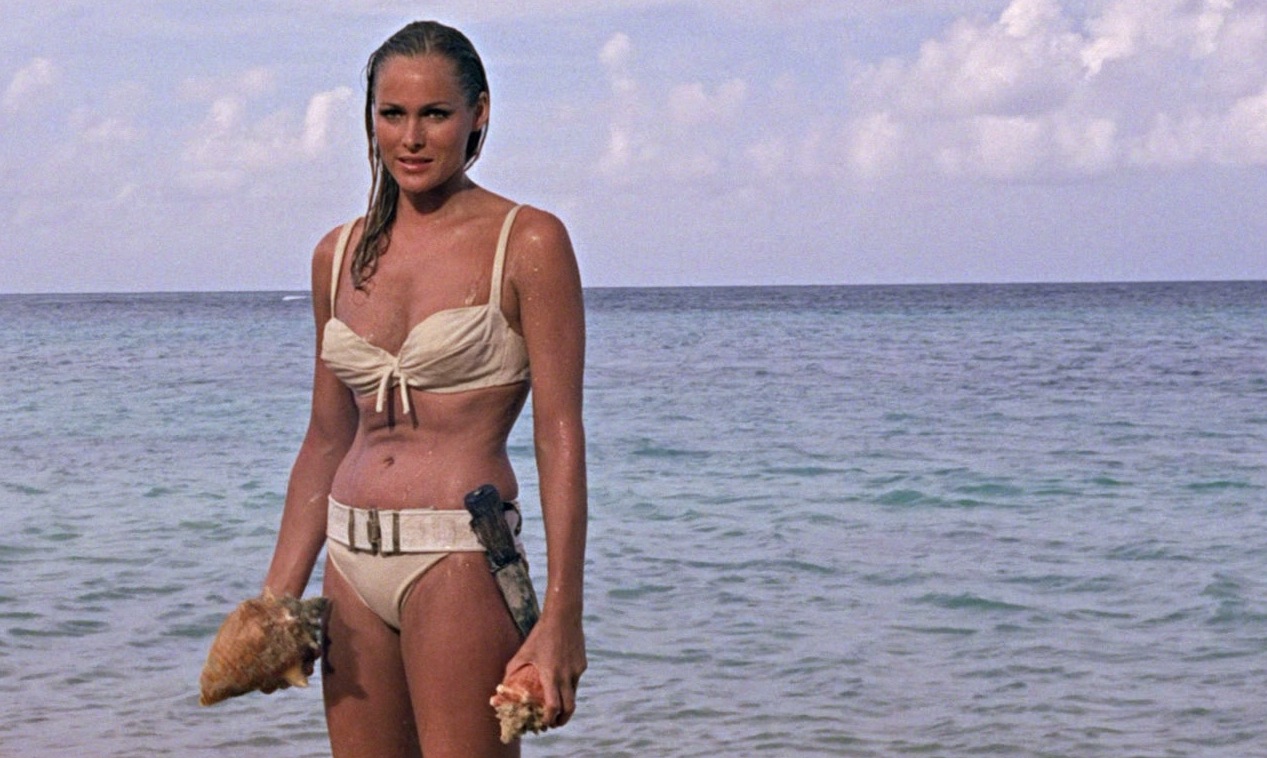
Honey Ryder
Ursula Andress
Dr.No (1962)
Tatiana Romanova
Daniela Bianchi
From Russia With Love (1963)
Jill Masterson
Shirley Eaton
Goldfinger (1964)
Pussy Galore
Honor Blackman
Goldfinger (1964)
Domino
Claudine Auger
Thunderball (1965)
Fiona Volpe
Luciana Paluzzi
Thunderball (1965)
Tracy Draco (Bond)
Diana Rigg
On Her Majesty’s Secret Service (1969)
Mary Goodnight
Britt Ekland
The Man With The Golden Gun (1974)
Anya Amasova
Barbara Bach
The Spy Who Loved Me (1977)
Octopussy
Maud Adams
Octopussy (1983)
Pam Bouvier
Carey Lowell
Licence To Kill (1989)
Natalya Simonova
Izabella Scorupco
GoldenEye (1995)
Wai Lin
Michelle Yeoh
Tomorrow Never Dies (1997)
Christmas Jones
Denise Richards
The World Is Not Enough (1999)
Jinx
Halle Berry
Die Another Day (2002)
Vesper Lynd
Eva Green
Casino Royale (2006)
Strawberry Fields
Gemma Arterton
Quantum of Solace (2008)
Camille
Olga Kurylenko
Quantum of Solace (2008)
The Girl...
All Bond girls are, almost by definition, beautiful, and they follow a fairly well-developed pattern of beauty as well. They possess splendid figures and tend to dress in a slightly masculine, assertive fashion, with few pieces of jewelry and that in a masculine cut, wide leather belts, and square-toed leather shoes. (There is some variation in dress, though, and Bond Girls have made their first appearances in evening wear, in bra and panties and, on occasion, naked.) They often sport light though noticeable sun-tans (although a few, such as Solitaire, Tatiana Romanova, and Pussy Galore, are not only tanless but remarkably pale), and they generally use little or no makeup and no fingernail or toenail polish, also wearing their nails short. (Early Bond commentator O. F. Snelling maintained that the fact that Goldfinger's Jill Masterton is painting her fingernails when Bond first encounters her is a tip-off that she will not be the novel's main Bond Girl, and, indeed, Goldfinger has her killed after her brief liaison with Bond.) Their hair may be any color ranging from red (Natalya Simonova), to blonde (Mary Goodnight) to auburn (Gala Brand) to brown (Tatiana Romanova) to blue-black (Solitaire) to black (Vesper Lynd), though they typically wear it in a natural or casual cut that falls heavily to their shoulders. Their features, especially their eyes and mouths, are often widely spaced ( Vesper Lynd, Gala Brand, Tiffany Case, Tatiana Romanova, Honey Ryder, Viv Michel, Mary Goodnight). Their eyes are usually blue ( Vesper Lynd, Solitaire, Gala Brand, Tatiana Romanova, Honey Ryder, Viv Michel, Tracy Bond, Mary Goodnight), and sometimes this is true to an unusual and striking degree: Tiffany Case's eyes are chatoyant, varying with the light from gray to gray-blue, while Pussy Galore has deep violet eyes, the only truly violet eyes that Bond had ever seen. The first description of a Bond Girl, Casino Royale's Vesper Lynd, is almost a template for the typical dress as well as the general appearance of later Bond Girls; she sports nearly all of the features discussed above. In contrast, Dominetta "Domino" Vitali arguably departs to the greatest degree from the template, being relatively old (29), dressing in white leather doeskin sandals, having brown eyes and a tan arguably heavier than other Bond Girls, sporting a soft Brigitte Bardot haircut, and giving no indication of widely-spaced features. (The departure may be due to the unusual circumstances behind the writing of the novel Thunderball, in which Domino appears.) Even Domino, however, wears rather masculine jewelry.
The best-known characteristic of Bond Girls except for their uniform beauty is their pattern of suggestive names (the most risqué and famous being Pussy Galore). Some of these, but not all, have explanations in the novels. While Solitaire's real name is Simone Latrelle, she is known as Solitaire because she excludes men from her life; Gala Brand, as noted above, is named for her father's cruiser, HMS Galatea; and Tiffany Case received her name from her father, who was so angry that she was not a boy that he gave her mother a thousand dollars and a compact from Tiffany's and then walked out on her. Conjecture is widespread that the naming convention began with the first Bond novel Casino Royale, in which the name "Vesper Lynd" is a pun on West Berlin, signifying Vesper's divided loyalties (she is a double agent under Soviet control). Several Bond Girls, however, have normal names (Tatiana Romanova, Mary Ann Russell, Judy Havelock, Viv Michel, Tracy Bond [Teresa Draco, aka Contessa Teresa di Vicenzo]).
Most Bond Girls are apparently (and sometimes expressly) sexually experienced by the time they meet Bond (although there is evidence that Solitaire is a virgin). Not all of their experiences, however, are positive, and many (though by no means all) Bond girls have a history of sexual violence that often alienates them from men (until Bond comes along). This darker theme is notably absent from the early films. Tiffany Case was gang-raped as a teenager; Honey Ryder, too, was beaten and raped as a teenager by a drunken acquaintance. Pussy Galore was subjected at age 12 to incest, and rape, by her uncle. While there is no such clear-cut trauma in Solitaire's early life, there are suggestions that she, too, avoids men because of their unwanted advances in her past. Kissy Suzuki reports to Bond that during her brief career in Hollywood when she was 17 "They thought that because I am Japanese I am some sort of an animal and that my body is for everyone." The inference is that these episodes often (though not always) turn the Bond Girls in question against men, though upon encountering Bond they overcome their earlier antipathy and sleep with him not only willingly but eagerly. The cliché reaches its most extreme (some would say absurd) level in Goldfinger. In this novel Pussy Galore is clearly a practicing lesbian when she first meets Bond, but at the end of the novel she sleeps with him. When, in bed, he says to her "They told me you only liked women," she replies "I never met a man before."
Many Bond Girls have some sort of independent job or even career, and often it is not a particularly respectable one for 1950s women. Vesper Lynd, Gala Brand, Tatiana Romanova, Mary Ann Russell, and Mary Goodnight are in intelligence or law enforcement work. By contrast, Tiffany Case and Pussy Galore are very independent-minded criminals, the latter even running her own syndicate. Most other Bond Girls, even when they have more conventional or glamorous jobs, show an investment in their independent outlook on life. While the Bond Girls are clearly intended as sex objects, they nevertheless have a degree of independence that the Bond films tended to dispense with until nearly 1980. It was the films, therefore, that turned the Bond Girl into purely a sex object.
Most of the novels focus on one particular romance, as some of them do not occur for a while into the novel ("Casino Royale" is a good example). However, three exceptions have been made: In Goldfinger, the Masterton sisters are considered Bond girls (although Tilly is a lesbian), and after their deaths, Pussy Galore (also a lesbian) becomes the primary Bond girl. In Thunderball, Bond romances Patricia Fearing, followed by Domino Vitali. In You Only Live Twice, Bond has relationships with Kissy Suzuki, mainly, but also romances Mariko Ichiban, and a girl so insignificant that she is unnamed.
Several Bond girls have obvious signs of inner turmoil (Vesper Lynd or Vivienne Michel), and others have traumatic pasts. Most Bond girls that are allowed to develop are flawed, and several have unhappy sexual backgrounds (Honey Ryder, Pussy Galore, Tiffany Case, Vivienne Michel, and Kissy Suzuki, among others). It is perhaps this vulnerability that draws them to Bond.